Introduction: The Billion-Dollar Backbone of Offshore Energy
If you ask anyone in the offshore energy industry what defines success in 2025, you’ll hear a mix of familiar words: safety, efficiency, and sustainability. Whether it’s a deepwater oil platform in the Gulf of Mexico, an offshore wind farm in the North Sea, or a subsea cable route across the Atlantic, the ability to manage complex projects under harsh marine conditions is the difference between profit and loss.
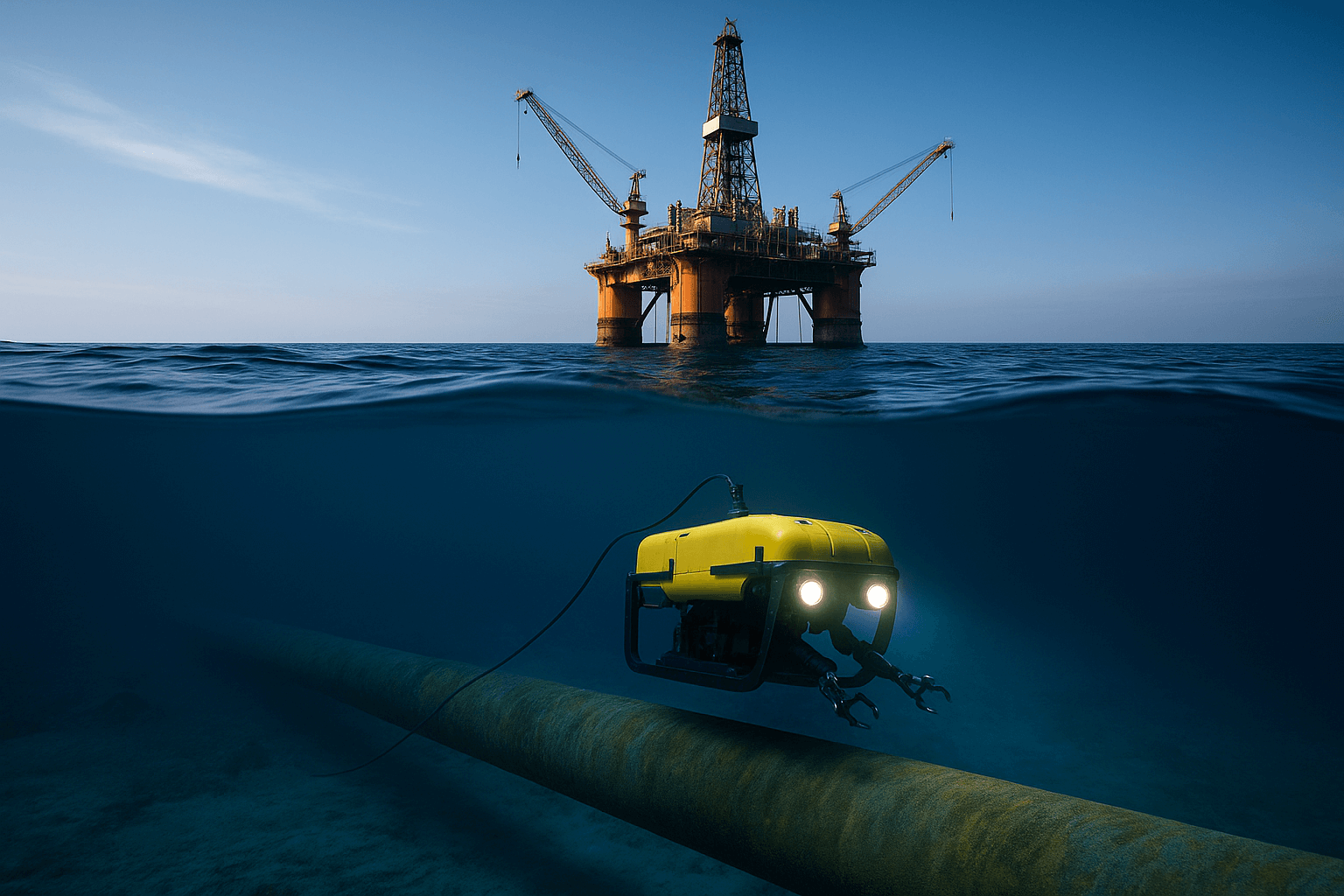
And behind the scenes, doing the invisible, high-risk, high-value work? ROVs (Remotely Operated Vehicles) and AUVs (Autonomous Underwater Vehicles).
These subsea robots are not just tools anymore — they’ve become the silent workhorses of the offshore world. They replace divers in dangerous depths, cut downtime for billion-dollar rigs, and deliver 3D digital twins of subsea assets in real-time. In 2025, ROVs and AUVs are transforming how we build, inspect, and sustain offshore energy infrastructure.
This isn’t just about shiny new tech; it’s about how offshore energy projects worth hundreds of millions of dollars each are made safer, cheaper, and more reliable.
👉 Learn more about how Nautrex connects clients with trusted providers for ROV & AUV Operations.
What Exactly Are ROVs and AUVs?
Before diving into their impact, let’s clear the basics.
- ROVs (Remotely Operated Vehicles):
These are tethered robots piloted from the surface via a support vessel. Think of them as robotic divers — equipped with cameras, manipulators, cutting tools, and sensors. They excel in precision tasks: turning valves, cutting pipelines, or placing subsea equipment. - AUVs (Autonomous Underwater Vehicles):
These are untethered, torpedo-shaped vehicles that run on pre-programmed missions. They’re designed for survey and mapping, often covering hundreds of kilometers while collecting bathymetric, sonar, and environmental data.
Together, they’re complementary. AUVs map and monitor, while ROVs intervene and repair.
Offshore Energy Before Subsea Robotics: The Old Bottlenecks
The offshore world didn’t always have these robotic allies. For decades, operations relied on:
- Divers working in extreme depth, with limited bottom time and high risk.
- Manned submersibles — expensive, complex, and limited by depth.
- Surface-based surveys — slow and often imprecise for deepwater assets.
The result? Cost overruns, safety incidents, and downtime that could cost operators millions of dollars per day.
Enter robotics — and suddenly the rules changed.
How ROVs Are Transforming Oil & Gas Projects
Offshore oil and gas still dominates subsea construction budgets. ROVs in particular have become indispensable for:
1. Pipeline Inspection & Repair
Every kilometer of subsea pipeline (and there are hundreds of thousands worldwide) must be inspected for leaks, corrosion, and structural integrity. ROVs equipped with HD cameras, sonar, and UT probes can:
- Detect anomalies faster than divers.
- Execute repairs in situ.
- Reduce inspection times by up to 40%.
2. Platform Maintenance
From flare stacks to subsea risers, platforms depend on continuous monitoring. ROVs can replace divers for:
- Cleaning biofouling.
- Checking welds and joints.
- Conducting NDT (non-destructive testing).
3. Decommissioning Projects
The oil industry is retiring aging rigs, creating a surge in subsea cutting and removal. ROVs are the only safe way to cut thick pipelines and recover modules in deepwater conditions.
How AUVs Are Transforming Offshore Wind
Offshore wind is the fastest-growing energy sector, and AUVs are its survey heroes.
1. Seabed Mapping for Turbine Placement
Before a wind farm is installed, developers need detailed bathymetric surveys. AUVs:
- Scan the seabed with multibeam sonar.
- Identify obstructions, ridges, and sediment conditions.
- Deliver gigabytes of 3D data in days rather than weeks.
2. Cable Route Survey & Burial Monitoring
Export cables and inter-array cables are the lifelines of offshore wind. AUVs map optimal routes and monitor them post-installation. In 2025, AUVs are now equipped with magnetometers and sub-bottom profilers that detect burial depths and scour around cables.
3. Foundation & Scour Monitoring
Wind turbine foundations are prone to scour (erosion around their base). AUVs and small inspection ROVs provide real-time monitoring, allowing corrective action before structural issues occur.
Technology Drivers in 2025
The year 2025 is special because of several converging technology breakthroughs:
- AI & Autonomy: AUVs are now equipped with onboard AI that allows adaptive missions (e.g., if an anomaly is found, the vehicle reroutes to investigate further).
- Battery Technology: Next-gen lithium and hybrid power systems extend AUV missions to 48–72 hours underwater.
- Data Streaming: ROVs now deliver real-time high-bandwidth video and sensor data directly to onshore operations centers.
- Digital Twins: Offshore platforms and wind farms now have digital replicas updated live by ROV and AUV data. This means predictive maintenance instead of reactive repair.
The Economics: Cost, Safety & Efficiency Gains
The impact of robotics on offshore energy isn’t just technical — it’s financial.
- Cost Savings: A single ROV campaign can reduce inspection costs by 30–50% compared to diver operations.
- Safety: By replacing humans in deepwater, fatalities and incidents drop significantly.
- Efficiency: Faster surveys and real-time data mean less downtime for rigs and turbines.
For oil & gas majors and wind developers, these savings translate into millions per year per asset.
Future Outlook: What’s Next Beyond 2025?
We’re only scratching the surface. Looking forward:
- Swarm Robotics: Fleets of AUVs working together to map entire fields in parallel.
- Permanent Resident ROVs: Tethered to subsea docking stations, always available for quick deployment.
- AI-Driven Predictive Maintenance: Systems that detect anomalies before they even become a problem.
- ROV-as-a-Service Models: Pay-per-use contracts instead of owning fleets.
The implication is clear: subsea robotics will no longer be a “nice-to-have” but a fundamental backbone of offshore energy projects.
How Nautrex Helps You Harness ROV & AUV Operations
At Nautrex, we’ve seen this transformation first-hand. Our platform connects energy companies, contractors, and governments with verified providers specializing in ROV & AUV services.
Whether it’s:
- Deepwater pipeline inspection.
- Offshore wind farm cable surveys.
- Subsea construction support.
- Hydrographic mapping missions.
…you’ll find trusted partners listed under our ROV & AUV Operations category.
Nautrex ensures every provider is vetted for compliance, capability, and reliability — because when you’re running projects worth tens or hundreds of millions, there’s no room for error.
Conclusion: The Silent Workhorses of 2025
ROVs and AUVs may not make headlines like offshore wind megaprojects or oil price swings, but they’re the quiet heroes making those stories possible. In 2025, they’re transforming offshore energy from the seabed up: making it safer, faster, and smarter.
The bottom line? If you’re in the offshore energy business and you’re not already investing in subsea robotics, you’re falling behind.
👉 Explore trusted providers today at Nautrex.