Introduction
Some projects aren’t just infrastructure — they’re statements of what humanity can achieve when it decides to push the limits. Offshore subsea construction is one of those frontiers.
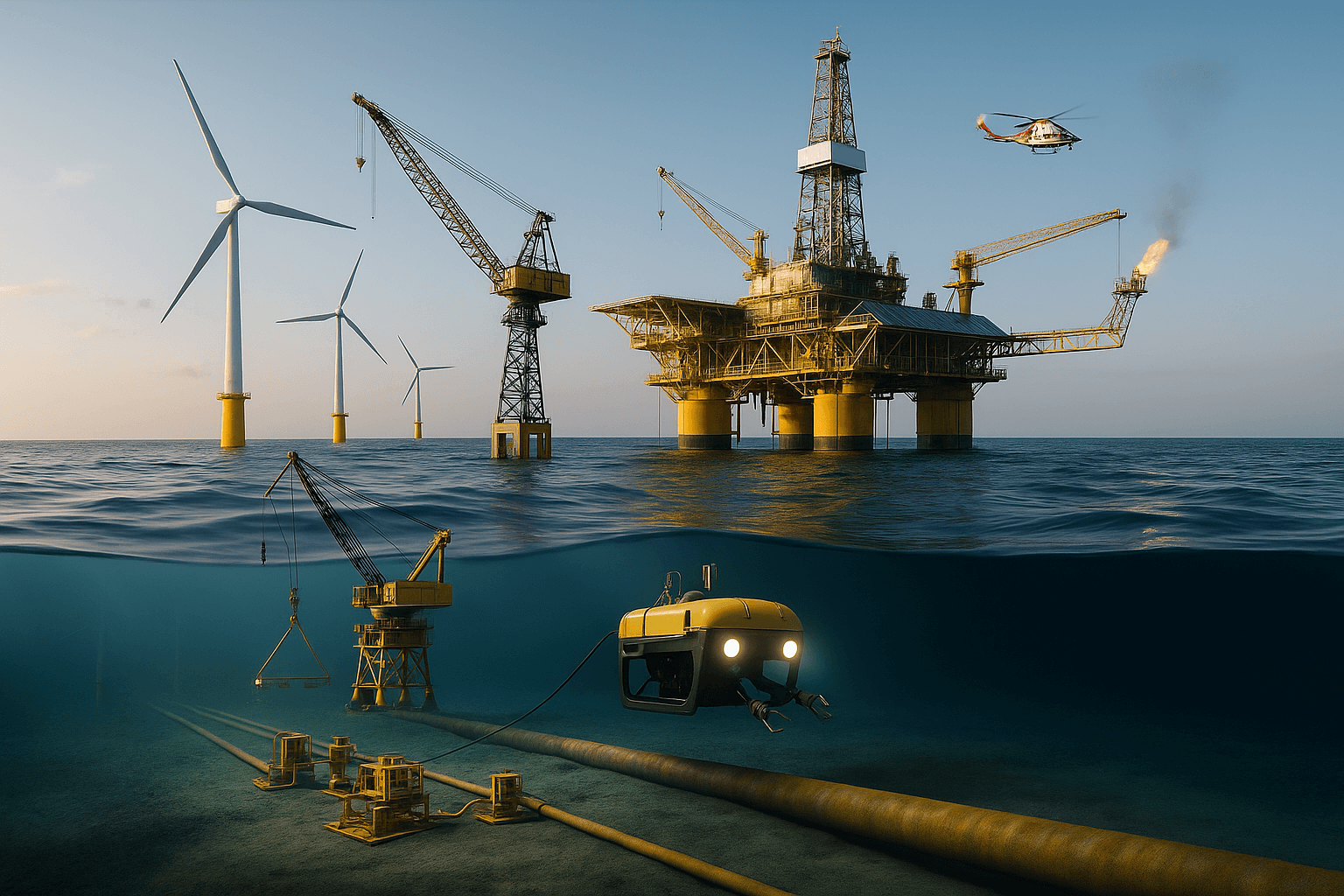
From pipelines that stretch across oceans, to wind farms the size of cities rising from the seafloor, these mega-projects reshape economies, fuel industries, and write new chapters in engineering history. They are not small contracts; they’re multi-billion-dollar endeavors involving fleets of vessels, armies of specialists, and technologies that only existed in science fiction a generation ago.
And today, in 2025, subsea construction is undergoing a profound transformation. Robotics, artificial intelligence, and renewable energy demands are redefining not only how we build under the waves, but also why. Offshore engineering is no longer just about oil and gas; it’s about the energy future of entire nations.
👉 At Nautrex, we see these shifts every day, connecting clients with the world’s most capable subsea construction providers.
What Is Subsea Construction?
The Scope of Underwater Mega-Engineering
Subsea construction is the art and science of building massive infrastructure on the ocean floor. It covers:
- Pipelines & Risers carrying oil, gas, or hydrogen.
- Manifolds & Wellheads for subsea oil production.
- Platform Foundations & Jackets anchoring colossal rigs.
- Turbine Foundations for offshore wind farms.
- Cables stretching thousands of kilometers to deliver energy to shore.
It is, by definition, mega-project territory. Projects can run into tens of billions of dollars and span entire decades, from exploration to decommissioning.
Why It’s a “Mega-Project” Arena
Unlike land-based construction, subsea projects face crushing pressures, unpredictable currents, and depths no human diver can endure. Every decision costs millions. Every misstep can halt national energy supply. And every success advances the frontier of what offshore engineering can deliver.
Offshore Oil & Gas Mega-Projects
Deepwater Drilling & Subsea Production Systems
Oil and gas remain the backbone of subsea construction investment. Fields like Brazil’s pre-salt reserves or West Africa’s deepwater basins are far too complex for traditional rigs. Instead, they rely on:
- Subsea manifolds the size of small houses.
- Flowlines laid across miles of seabed.
- Control umbilicals that resemble underwater nervous systems.
ROVs (Remotely Operated Vehicles) handle the installations, guided from surface vessels, while heavy-lift cranes lower modules weighing thousands of tons into place.
Pipelines & LNG Terminals
Some pipelines cross not just kilometers, but entire seas. Consider the Nord Stream, or trans-Mediterranean gas links. Building them required laying steel tubes across uneven seabeds, welding sections underwater, and securing them against geological instability.
Similarly, offshore LNG terminals — floating giants — demand subsea moorings, risers, and supply connections that can handle massive volumes under extreme stress.
Decommissioning Challenges
As many platforms age, subsea construction is also about removing old infrastructure. Decommissioning has become its own mega-project sector — cutting, lifting, and safely disposing of structures without damaging marine ecosystems.
Offshore Wind & Renewable Mega-Projects
Large-Scale Turbine Foundations
The North Sea has transformed into a skyline of steel turbines, each standing as tall as the Eiffel Tower. Foundations for these giants are driven deep into the seabed or stabilized by jackets weighing thousands of tons. Constructing one farm can involve hundreds of such foundations, turning the seabed into an engineered grid.
Subsea Cable Networks
What good are turbines without cables? Offshore wind depends on vast subsea cable networks to bring power ashore. These cables must withstand harsh currents, fishing activity, and decades of saltwater exposure. Cable-laying vessels now deploy with precision-guided burial plows, supported by ROVs for monitoring and repairs.
Hybrid Offshore Energy Hubs
The latest vision? Hybrid platforms that combine wind, wave, and even hydrogen production in a single offshore hub. Subsea construction is central to making these futuristic concepts possible — tying together multiple energy sources into one grid-connected facility.
Technology Transforming Subsea Construction in 2025
ROVs & AUVs
No subsea mega-project can progress without fleets of ROVs and AUVs. These robotic vehicles are now equipped with:
- AI for anomaly detection.
- Manipulator arms capable of precision cutting and installation.
- Real-time video streaming back to shore-based control rooms.
They have replaced dangerous diver missions and accelerated timelines.
Heavy-Lift Vessels
Mega-projects require mega-vessels. Heavy-lift ships like the Pioneering Spirit can install entire topside modules or remove old platforms in one piece. Their presence is often the most visible proof of a subsea mega-project’s scale.
Digital Twins & AI
Entire offshore fields are now replicated digitally. Every manifold, pipeline, and foundation has a “twin” in cyberspace that updates in real-time thanks to sensor and ROV data. Engineers can simulate stress, predict failure, and plan maintenance without stepping foot offshore.
Economic, Safety & Environmental Dimensions
Billion-Dollar Budgets
To put things into perspective:
- A single deepwater project can exceed $20 billion in total cost.
- Offshore wind clusters can rival national infrastructure budgets.
Subsea construction is not about “projects” — it’s about national investments in energy security.
Risk Management
Every day offshore costs money. Delays can mean millions lost. That’s why subsea construction integrates risk modeling, real-time monitoring, and highly specialized insurance frameworks.
Sustainability & ESG Pressures
Unlike 20 years ago, subsea projects now face scrutiny not just for cost but for carbon footprint and ecological impact. From noise pollution during pile-driving to habitat disruption, subsea construction must balance progress with protection.
The Future of Offshore Engineering Mega-Projects
Floating Wind
Imagine turbines not fixed to the seabed but floating like anchored ships. Floating wind is no longer theory — it’s real, and it’s expanding. This unlocks deepwater areas where fixed foundations are impossible. Subsea moorings and dynamic cables become the next mega-project challenges.
Carbon Capture & Hydrogen Subsea Infrastructure
As nations race to decarbonize, subsea construction will expand into CO₂ storage reservoirs and hydrogen transport pipelines. These require the same scale of engineering as oil and gas but serve a completely new purpose.
Integration with Smart Grids
The future offshore grid will look more like the internet — interconnected, flexible, and smart. Subsea hubs will route power from wind farms, tidal generators, and storage sites to onshore grids, adapting in real-time to demand.
How Nautrex Connects You to Subsea Construction Experts
At Nautrex, we believe subsea construction isn’t just about steel and concrete — it’s about ambition, trust, and execution. We connect clients with providers who have the vessels, robotics, and expertise to deliver projects on this mega scale.
Whether you’re planning:
- A deepwater oil and gas field,
- A floating wind farm, or
- A subsea decommissioning program,
…Nautrex ensures you access certified experts who keep projects safe, compliant, and productive. Explore our dedicated Subsea Construction & Offshore Support category to find specialists ready to take on your challenge.
Conclusion
Subsea construction is the quiet epic of modern engineering. It doesn’t always make headlines, but it builds the backbone of global energy. It’s in the pipelines that heat homes, the turbines that power cities, and the platforms that fuel industries.
In 2025, these mega-projects represent not only human ingenuity but also a vision of what the future can look like — safer, smarter, and more sustainable. Offshore engineering has always been about pushing boundaries, and today it pushes further than ever before.
The seabed, once untouchable, is now a construction site for the future of energy. And with platforms like Nautrex, you don’t just watch this transformation — you participate in it.