Introduction
When a ship the size of a skyscraper runs aground or sinks, the world takes notice. The images go viral: a container giant stranded sideways in a canal, a cruise ship lying on its side off the coast, or a tanker split in half after a storm. But what comes after the headlines is a story few ever hear — the salvage operation.
Behind the scenes, teams of divers, engineers, ROV pilots, heavy-lift vessel captains, and environmental specialists converge on the site. The stakes? Enormous. Lives may be at risk. Cargo worth billions could be lost. Oil spills threaten coastlines. Insurance claims spiral into hundreds of millions. And the world’s shipping lanes — the arteries of global trade — hang in the balance.
This is the world of $100M salvage operations. They are part rescue mission, part engineering marvel, and part race against time. And in 2025, they remain among the most complex and daring projects in offshore engineering.
👉 Discover how Nautrex connects you with trusted specialists in Marine Salvage & Recovery.
What Makes Salvage Operations Worth $100M+?
High-Value Cargo
Modern vessels don’t just carry steel and coal. They transport smartphones, cars, energy supplies, and even hazardous chemicals. A single container ship can hold $500M worth of cargo. Losing that cargo isn’t just an economic hit — it’s a global supply chain crisis.
Insurance-Driven Economics
Marine insurance underwriters know one fact well: salvage is cheaper than total loss. Spending $100M to recover a vessel or cargo is justified if it prevents a $1B claim. This financial logic fuels the investment in mega salvage operations.
Strategic Importance
Many salvages aren’t about cargo at all. They’re about geography. A blocked canal like the Suez, or a sunken vessel in a critical shipping lane, can paralyze trade routes that account for 10–12% of global commerce. Clearing them quickly is worth billions to the global economy.
Phases of a Mega Salvage Operation
Assessment & Stabilization
The first step is understanding the wreck. Salvors deploy divers, ROVs, and sonar mapping tools to assess hull integrity, seabed conditions, and hazards. Stabilization follows: patching holes, reinforcing structures, or preventing further sinking.
Cargo & Pollution Control
Before a ship can be moved, cargo and fuel must be dealt with. This means:
- Offloading containers one by one, often using floating cranes.
- Pumping out oil or fuel to prevent catastrophic spills.
- Securing hazardous goods to protect both crew and environment.
Heavy Lifting & Refloating
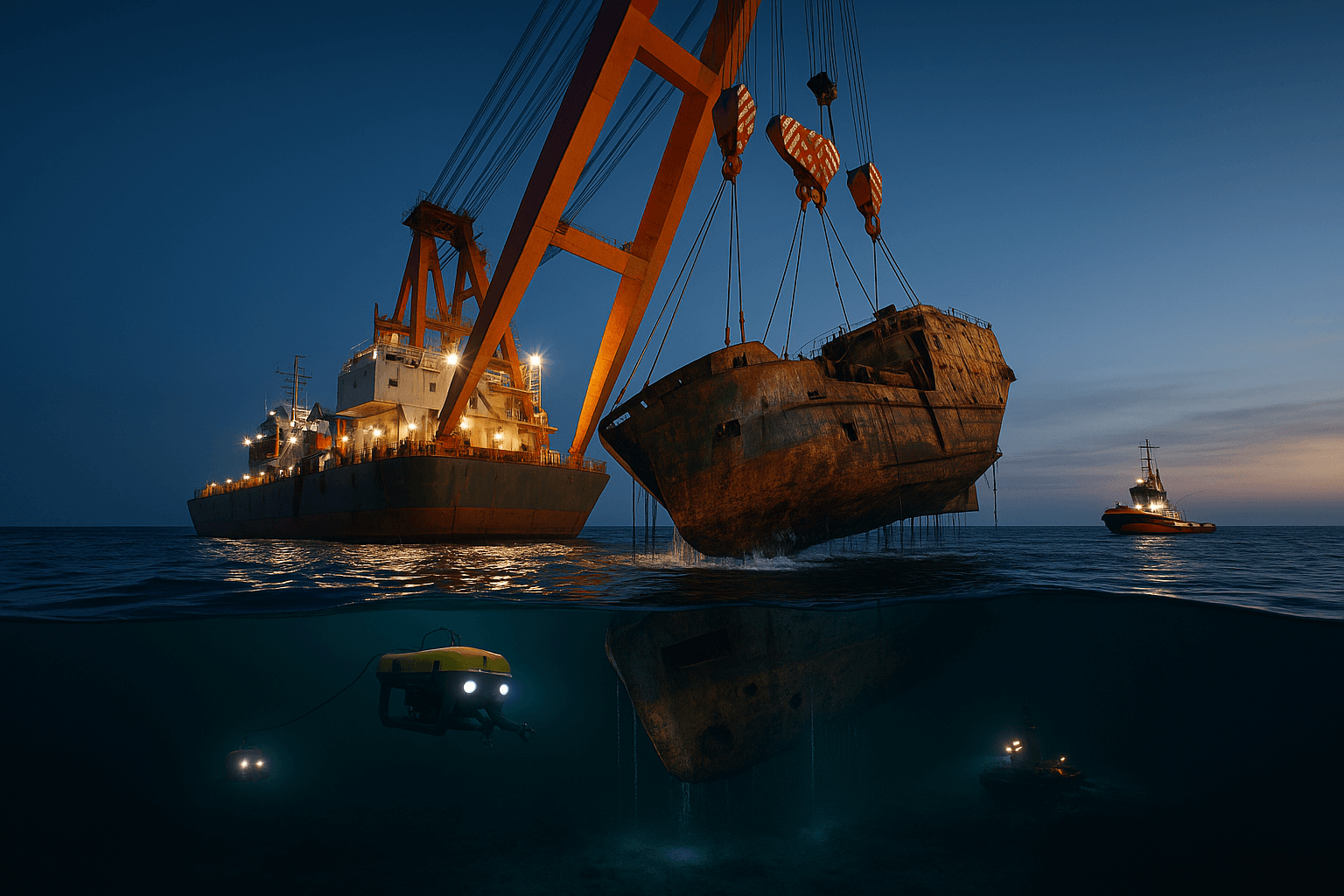
This is the dramatic part the world sees. Gigantic cranes, pontoons, and airbags work together to lift or refloat the vessel. In some cases, entire sections are cut apart underwater using diamond wire saws and raised piece by piece.
Towage & Final Disposal
Once afloat, vessels are towed to shipyards for repair, scrapping, or recycling. Salvage ends only when the wreck no longer poses a danger to navigation or the environment.
Technologies Behind Mega Salvage Projects
ROVs & AUVs
ROVs (Remotely Operated Vehicles) inspect damage at depths no diver can safely reach. They cut steel, weld patches, and provide live video feeds to control rooms. AUVs (Autonomous Underwater Vehicles) map wreck sites with sonar, creating 3D models critical for planning.
Heavy-Lift Cranes & Barges
Some salvage cranes can lift 10,000 tons in a single hoist. Barges carry these cranes to the site, forming floating construction yards. Without them, lifting a cruise ship or tanker would be impossible.
Buoyancy Aids & Subsea Cutting
Inflatable pontoons and buoyancy bags can raise smaller ships by attaching to hulls. For massive wrecks, subsea cutting techniques — from oxy-arc torches to explosives — are used to section the ship into manageable parts.
Risks, Regulations & Insurance Dimensions
International Maritime Rules
Salvage isn’t just about engineering — it’s about law. The International Maritime Organization (IMO) sets rules to ensure salvages prioritize safety and environmental protection.
Lloyd’s Open Form (LOF)
Most high-value salvages are contracted under LOF, a unique “no cure, no pay” system. Salvors are only paid if they succeed, often earning a percentage of the value saved. For $100M operations, rewards can reach staggering sums.
Environmental Liability
With global pressure on sustainability, salvors must now account for ecological risks. An oil spill from a wreck can cost more in penalties and damages than the ship itself.
Legal Disputes
Ownership of wrecks, salvage rights, and cargo claims often lead to years of legal wrangling. Salvage is as much a courtroom battle as it is an engineering one.
Case Studies of Iconic Salvage Operations
Costa Concordia (Italy, 2012–2014)
When the cruise ship Costa Concordia capsized off the Italian coast, it became one of the most complex salvage operations in history.
- Cost: Over $1.2 billion.
- Process: Refloated using sponsons and massive steel platforms.
- Scale: Involved 500 workers, 30 vessels, and 2 years of work.
Ever Given (Suez Canal, 2021)
The Ever Given container ship blocked the Suez Canal for 6 days, freezing 12% of global trade.
- Salvage: Excavators, dredgers, tugboats, and spring tides combined to free it.
- Global Impact: Estimated $400M per hour in trade disruption.
Tanker Salvage Examples
From oil tankers in the Persian Gulf to chemical carriers in Asia, tanker salvages often involve removing dangerous cargo before lifting. These are some of the riskiest jobs, requiring precision to avoid environmental disaster.
The Future of Marine Salvage
Autonomous Salvage Robots
By 2030, fleets of autonomous robots may patrol wrecks, cutting, welding, and lifting without direct human control. This could slash costs and risks.
Green Salvage Methods
Eco-friendly fuels for salvage vessels, noise reduction for marine life, and recycling-oriented wreck disposal are on the rise. Future salvages won’t just focus on recovery — they’ll focus on sustainability.
Faster Emergency Mobilization
The industry is moving toward pre-positioned global salvage fleets. Instead of waiting weeks, the goal is to mobilize within hours, reducing both cost and damage.
How Nautrex Connects You to Salvage Experts
At Nautrex, we understand that salvage isn’t just about raising ships — it’s about saving livelihoods, protecting ecosystems, and keeping trade flowing.
Through our Marine Salvage & Recovery category, you can connect with:
- Global salvage contractors.
- ROV and AUV service providers.
- Heavy-lift specialists.
- Environmental response teams.
From emergency wreck removal to planned decommissioning, Nautrex ensures you find trusted experts to handle the biggest challenges offshore.
Conclusion
Salvage operations are a rare mix of drama, danger, and discipline. They’re the unsung stories behind viral shipwreck photos — the $100M missions that restore order when disaster strikes.
These projects remind us that the sea is powerful and unpredictable, but so too is human ingenuity. With cranes towering over the waves, ROVs working tirelessly in the dark, and fleets of ships coordinating like clockwork, salvage is the ultimate demonstration of what it means to rise to a challenge.
And as we move deeper into the future, one thing is clear: when vessels falter and the world holds its breath, salvage will always answer the call.