Introduction
For centuries, stories of shipwrecks and sunken cities have captured human imagination. From legends of Atlantis to tales of lost treasure, the ocean has always held secrets. But what was once the realm of myth, speculation, and dangerous free-diving has now become a cutting-edge science: marine archaeology.
Today, archaeologists don’t just rely on divers with flashlights. They deploy fleets of ROVs, AUVs, sonar systems, and 3D modeling tools to uncover history with scientific precision. What used to take decades of guesswork can now be done in weeks. And every year, discoveries reshape what we know about trade, war, and civilizations that relied on the sea.
👉 At Nautrex, we help connect archaeologists and researchers with the technology and offshore expertise they need. Explore more in our Marine Archaeology category.
What Is Marine Archaeology?
Definition and Scope
Marine archaeology is the study of human interaction with the sea through material remains. It includes:
- Shipwrecks: From Bronze Age trading ships to WWII warships.
- Submerged Settlements: Ancient ports, harbors, and even entire towns lost to rising seas.
- Artifacts: Cargo, tools, weapons, and personal items that tell stories of life at sea.
Why It Matters
Marine archaeology isn’t just about treasure hunting. It’s about understanding:
- Trade Networks: How civilizations connected across oceans.
- Warfare: Naval battles that shaped nations.
- Climate Change: How rising seas and shifting coastlines forced migration.
- Cultural Identity: Preserving heritage before it disappears under development.
The Tech Revolution in Archaeology
ROVs and AUVs for Exploration
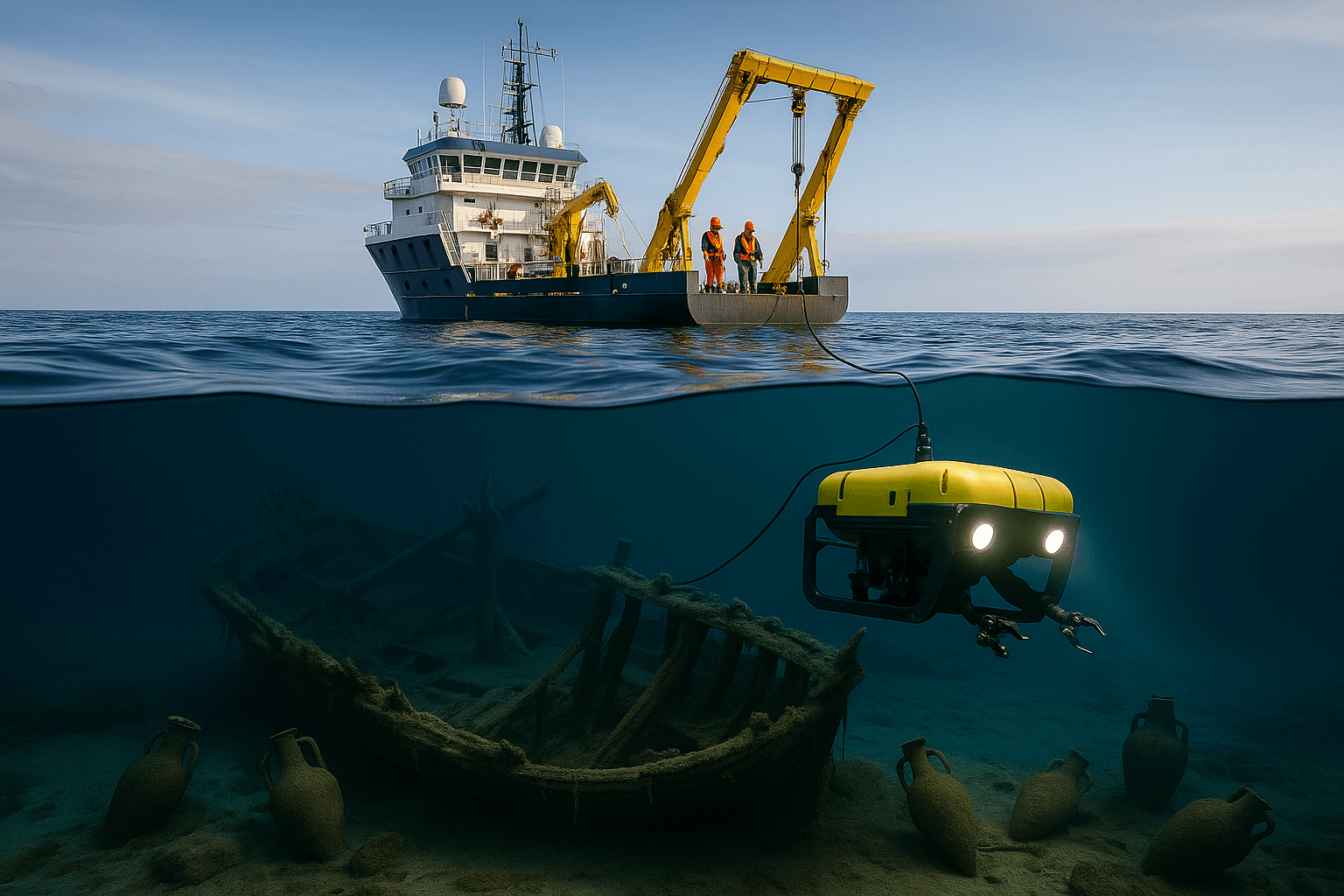
Remotely Operated Vehicles (ROVs) allow archaeologists to reach depths that divers cannot. They capture high-definition video, manipulate fragile objects, and work for hours without fatigue. AUVs (Autonomous Underwater Vehicles) map vast seafloor areas, scanning for anomalies that might indicate wrecks.
Multibeam Sonar and Magnetometers
Sonar systems paint the seabed with acoustic “eyes,” detecting wreck outlines buried in sediment. Magnetometers spot iron objects — cannons, anchors, hulls — even when invisible to cameras.
3D Mapping and Digital Twins
Today’s discoveries aren’t just cataloged in notebooks. They are turned into digital twins — precise 3D models that researchers and the public can explore virtually. A shipwreck off the coast of Egypt can now be toured by a student in Canada.
Famous Discoveries Shaped by Tech
Ancient Mediterranean Wrecks
In the Mediterranean, archaeologists discovered dozens of Greek and Roman wrecks using sonar and ROVs. These ships carried amphorae filled with wine, olive oil, and grain — the building blocks of ancient economies.
WWII Shipwrecks and Naval Archaeology
The Pacific is dotted with wrecks from WWII. Entire fleets lie preserved in deep waters, their stories revealed by AUVs scanning miles of ocean floor. These sites are not only historical but also sacred — war graves that must be treated with respect.
Lost Ports, Harbors, and Trade Routes
In India’s Gulf of Khambhat and Egypt’s Alexandria, surveys uncovered sunken ports that once connected civilizations. Technology revealed harbors lost for thousands of years, reshaping our understanding of maritime trade.
Marine Archaeology & Offshore Industry
Environmental and Cultural Impact Assessments
Offshore projects — from wind farms to pipelines — must ensure they don’t destroy archaeological sites. Surveys often reveal wrecks or settlements before construction begins, giving archaeologists a chance to study or protect them.
Collaboration with Energy Developers
Oil, gas, and offshore wind companies increasingly work with archaeologists. Protecting heritage has become a compliance requirement and a reputational advantage.
Legal and Ethical Frameworks
Marine archaeology is guided by laws like UNESCO’s Convention on the Protection of Underwater Cultural Heritage. Salvaging a wreck isn’t just technical — it’s political and ethical.
The Future of Marine Archaeology
AI for Artifact Recognition
Artificial intelligence is being trained to identify amphorae, anchors, or cannons in sonar images. This will allow surveys to process thousands of anomalies quickly, flagging likely archaeological sites.
Virtual Museums & Immersive Storytelling
Instead of removing artifacts from the seabed, archaeologists are creating digital exhibitions. Through VR and AR, anyone can walk through a wreck virtually, preserving both heritage and context.
Global Collaboration Networks
As climate change threatens coastlines, archaeologists are working with governments worldwide to document vulnerable sites before they vanish forever. Global collaboration ensures that discoveries are shared, not hoarded.
How Nautrex Supports Archaeology Projects
At Nautrex, we believe the past and future can work together. Through our Marine Archaeology services, we connect:
- Archaeologists with ROV/AUV specialists.
- Survey teams with cultural heritage experts.
- Developers with compliance-focused marine archaeologists.
Whether you’re uncovering a lost trade route or planning offshore construction, Nautrex ensures heritage is respected, preserved, and integrated into modern projects.
Conclusion
Marine archaeology is no longer about chance finds or adventurous dives. It is a fusion of history and high-tech — a discipline where ROVs, sonar, and AI meet ancient anchors, amphorae, and ship timbers.
Every discovery adds a piece to the puzzle of human history. Every survey protects heritage before it’s lost to storms, dredgers, or rising seas. And every digital twin or VR exhibition makes history accessible to the world.
The sea may still guard its secrets, but thanks to technology, we are unlocking them faster than ever.
👉 Explore how Nautrex connects explorers and engineers at Nautrex.